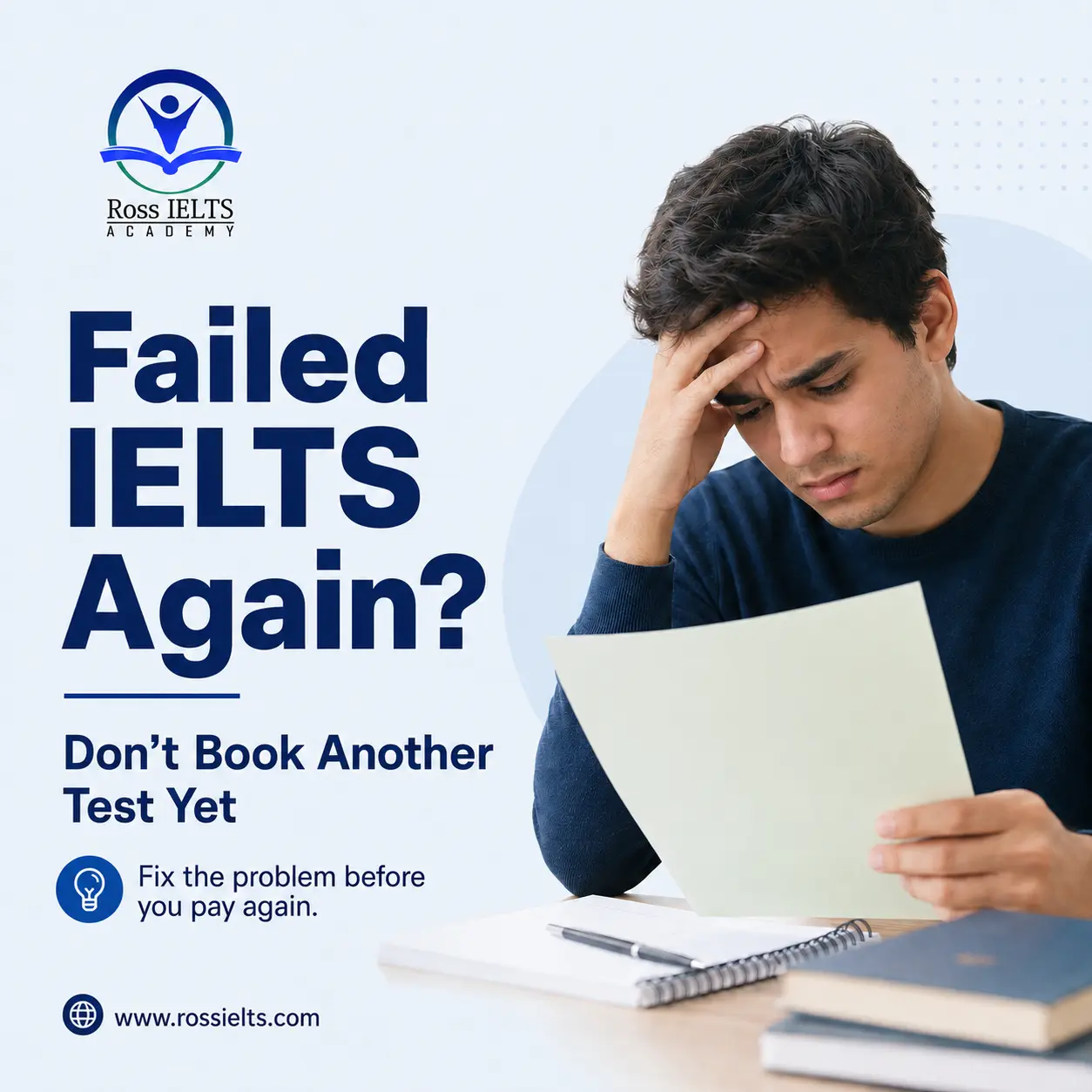
IELTS RETAKE · BEFORE YOU PAY AGAIN
You missed your target again. Should you simply book another IELTS test?
For many candidates, the first reaction is:
“I was only 0.5 away. I’ll take it again.”
Sometimes that makes sense. But if your preparation has not changed, another test may simply become another expensive measurement of the same weakness.
What can I do today that I could not do before my last IELTS test?
THE RETAKE TRAP
A new test date does not automatically create a new result
IELTS does not limit how many times you can retake the full test. But being allowed to retake it and being ready to retake it are two very different things.
REPEAT THE TEST
Same preparation → same weaknesses
You watch a few more videos, practise randomly, book another test and hope test-day luck gives you the missing 0.5.
FIX BEFORE RETAKING
Diagnose → improve → prove readiness
You identify what is actually limiting the score, work on it deliberately and retake only when your performance has changed.
THE QUESTION THAT MATTERS
If nothing has changed in your preparation,
why should the result change?
THE COST OF “I’LL JUST TRY AGAIN”
Repeated IELTS attempts can quietly cost thousands
Test fees vary by country, city and test centre. As a current Canada example, a full IELTS test can cost roughly CAD $335–$379 before tax.
1 FULL TEST
$335–$379
4 FULL TESTS
$1,340–$1,516
8 FULL TESTS
$2,680–$3,032
10 FULL TESTS
$3,350–$3,790
Canada example only, before applicable taxes. Actual IELTS fees vary by location and test centre.
And the exam fee is not the whole cost.
There may also be travel, time away from work, childcare, preparation time, immigration or university deadlines, and the mental cost of repeatedly receiving the same result.
SHOULD YOU RETAKE IELTS?
A retake can make sense—but only when there is a reason to expect a different performance
RETAKE MAY MAKE SENSE
DO NOT RUSH TO BOOK YET
RETAKE · ONE SKILL RETAKE · EOR
Before paying for another full test, check which option actually fits your situation
FULL IELTS RETAKE
Retake all four skills
This may be the right option when several skills are below target, you need a completely new full result, or the organisation receiving your score requires it.
ONE SKILL RETAKE
Retake only one skill
Eligible IELTS on computer candidates can retake one skill once per original full test, within 60 days.
Important for Canada:
IELTS One Skill Retake is currently not accepted for Express Entry.
ENQUIRY ON RESULTS
Request a re-mark
If you genuinely believe a score does not reflect your performance, you can consider an EOR. A re-mark request must normally be submitted no later than six weeks after the test date.
Universities, licensing bodies and immigration programs can have different rules for One Skill Retake and other result types.
A REAL ROSS IELTS ACADEMY STORY
8
ATTEMPTS
One student kept retaking IELTS before changing the preparation
One Ross IELTS student had already taken IELTS eight times without reaching the score they needed.
Eventually, instead of immediately paying for another attempt, the student changed the preparation approach, joined the Ross IELTS course and worked through structured preparation. On the next attempt, the student reached the required target.
Not the IELTS test. Not the scoring system. The preparation changed.
This is one student’s experience and does not guarantee the same outcome for every candidate.
WHAT SHOULD CHANGE BEFORE YOUR NEXT TEST?
Prepare for improvement—not simply another attempt
1. Learn
Understand the strategy, criteria and language skills behind the part you are struggling with.
2. Practise
Apply what you learned repeatedly instead of only watching lessons or reading tips.
3. Get Feedback
Find out what is still wrong, especially in Writing and Speaking where self-evaluation is difficult.
4. Get Test-Ready
Use timed assessments and realistic practice to confirm that improvement is becoming consistent.
5-QUESTION RETAKE CHECK
Are you actually ready to retake IELTS?
Answer honestly before you open the booking page.
SPEAKING IS YOUR PROBLEM?
Check your Speaking before paying for another real IELTS test
A diagnostic IELTS Speaking Mock Test can help you understand your estimated current level, the criteria limiting your performance and what you should work on before your next test.
THE SMARTER RETAKE
Take IELTS when you are ready to demonstrate improvement—not simply when you are ready to pay again.
IELTS Retake FAQ
How many times can I retake IELTS?
There is no official limit on the number of times you can take the full IELTS test. The more important question is whether your preparation and performance have changed enough to justify another attempt.
Should I retake IELTS if I missed my target by only 0.5?
Possibly, but do not make the decision based only on the size of the gap. Look at which skill was below target, whether the score is repeating across attempts, your current practice performance, and whether EOR or One Skill Retake is an accepted option for your purpose.
How soon can I retake the full IELTS test?
There is no mandatory waiting period for a normal full IELTS retake. However, taking another test immediately is not automatically a good strategy if you have not had enough time to improve the skill that limited your previous score.
Is IELTS One Skill Retake accepted for Express Entry?
No. IRCC currently states that IELTS One Skill Retake is not accepted for Express Entry. Always check the current requirements for the immigration, university or professional organisation receiving your score.
Should I request an EOR instead of retaking IELTS?
An Enquiry on Results may be worth considering if you genuinely believe your result does not reflect your performance. It is a re-mark, not a preparation strategy, and requests normally need to be submitted within six weeks of the test date.
Will taking IELTS repeatedly eventually improve my score?
Repetition alone does not create improvement. Your score is unlikely to increase unless you make a meaningful effort to improve before retaking the test.
Prepare smarter for your next IELTS attempt
Information in this guide is based on current IELTS, British Council, IDP Canada and IRCC guidance available at the time of publication. Test fees and acceptance rules can change, so always verify the requirements of your test centre and the organisation receiving your IELTS result. Ross IELTS Academy is an independent IELTS preparation provider and does not guarantee a particular IELTS band score.