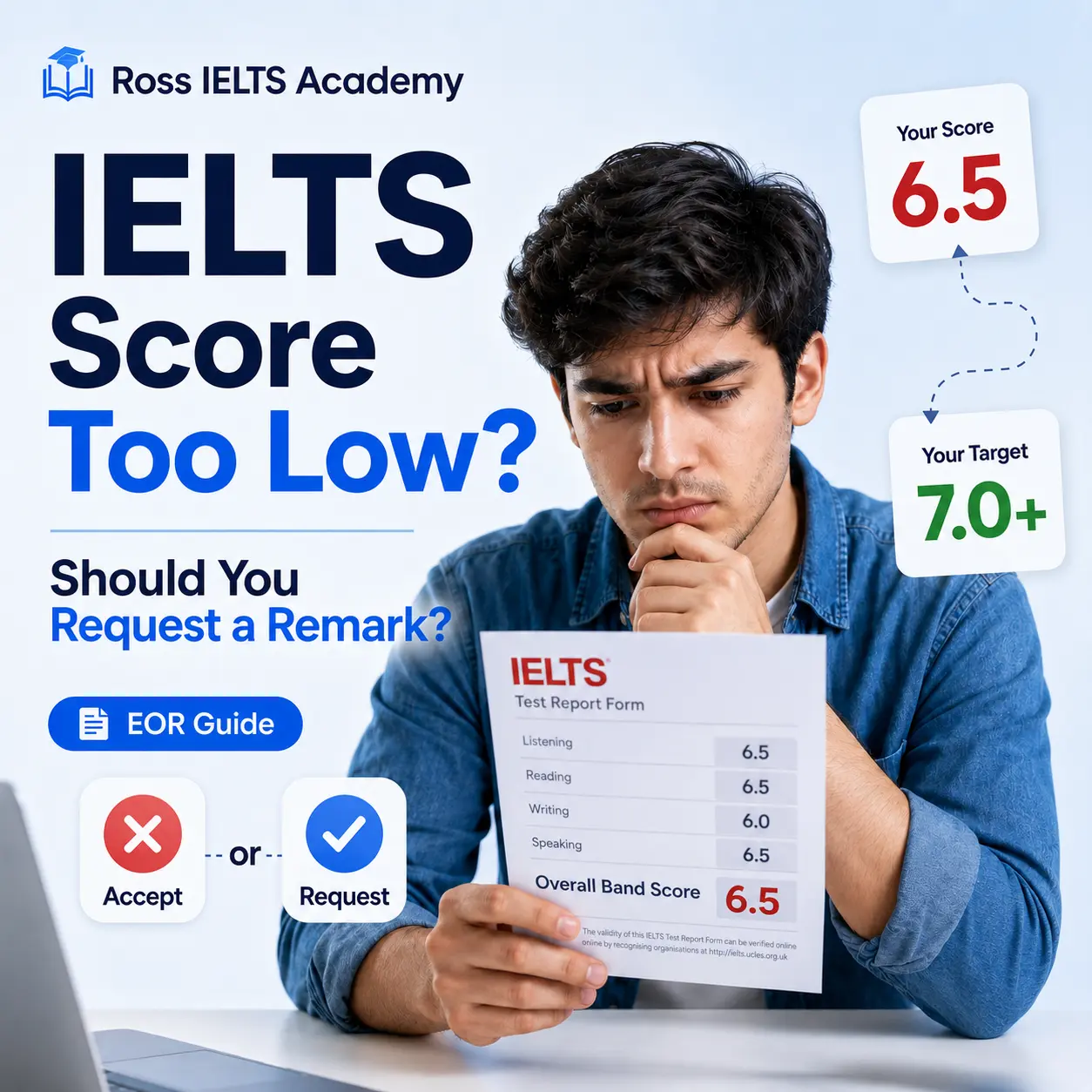
Your IELTS score is lower than expected—should you request a remark, book a One Skill Retake, or take the full test again?
This guide helps you decide whether an Enquiry on Results (EOR) is worth considering, explains exactly how to apply, and answers the most common questions about timing, fees, refunds, and score changes.
IELTS Remark: Quick Facts
What Is an IELTS Remark or EOR?
An IELTS remark is officially called an Enquiry on Results (EOR). It asks IELTS to review the score given to one or more sections of the test you have already completed.
What an EOR does
- Reviews the same test performance again
- Allows you to select one or more sections
- Uses senior examiners or markers for the review
- Issues an updated result if a band score changes
What an EOR does not do
- It is not a new IELTS test
- You cannot submit new answers
- It does not provide a corrected essay
- It does not give examiner notes or a detailed feedback report
According to the official IELTS EOR policy, selected test sections are reviewed by senior examiners or markers.
Should You Request an IELTS Remark?
A remark may be worth considering when the result is genuinely unexpected—especially if you need only a small increase. Use the two checklists below before paying the fee.
An EOR may be worth considering if:
- You are only 0.5 band below an important requirement.
- Your Writing or Speaking score is unexpectedly below your recent reliable assessments.
- You completed both Writing tasks and believe you addressed every part of the question.
- You did not experience an obvious problem during the test.
- Your deadline allows enough time for the review outcome.
- You understand that a score increase is possible, but never guaranteed.
A retake may be more realistic if:
- You know your performance was weaker than usual on test day.
- You left a Writing task incomplete or misunderstood the question.
- You gave short or underdeveloped Speaking answers.
- You missed many answers in Listening or Reading.
- You need a large increase rather than 0.5 band.
- Your result is consistent with your recent mock tests and feedback.
Which option may fit your situation?
| Your situation | A reasonable next option |
|---|---|
| The test felt strong, but one score is surprisingly low | Consider whether an EOR is justified |
| You know one skill went badly on test day | Check whether One Skill Retake is available and accepted |
| Several skills are below your target | Prepare for a full retake with a focused study plan |
| You need only 0.5 more in Writing or Speaking | Compare EOR, timing, fee, and your recent performance evidence |
| You are not sure whether the score reflects your real level | Get an independent weakness and level assessment first |
| Your university or organisation does not accept OSR | Compare EOR with a full IELTS retake |
| Your deadline is very close | Check EOR and retake timelines before choosing |
Why Can Your IELTS Score Feel Lower Than Expected?
A test can feel comfortable without meeting every requirement of the scoring
criteria. This is especially important in Writing and Speaking, where the
quality of your language is evaluated across several criteria—not simply
whether you finished or communicated your main idea.
In IELTS Speaking
You may have spoken continuously but still shown:
- repetition or weak organisation
- advanced but unnatural word choices
- repeated grammar errors
- limited idea development in Part 3
- understandable but inconsistent pronunciation
In IELTS Writing
Your response may have looked complete but still contained:
- an incomplete response to the task
- ideas that were not developed clearly
- frequent collocation or word-choice errors
- complex sentences with weak accuracy
- cohesion that felt mechanical or unclear
IELTS EOR vs One Skill Retake vs Full Retake
These options solve different problems. An EOR checks the score given to
your previous performance. One Skill Retake lets you perform one section
again. A full retake gives you a new result across all four skills.
| EOR / Remark | One Skill Retake | Full IELTS Retake |
|---|---|---|
| The same test performance is reviewed | You take one skill again | You take all four skills again |
| No new answers are submitted | You get a new chance to perform | You receive a completely new set of skill scores |
| Best considered when a score seems unexpected | Best considered when one test-day performance was weak | Best considered when several skills need improvement |
| Request within 6 weeks | Must normally be taken within 60 days of the full test | Book any available full test date |
| Fee is refunded if the band score changes | Fee varies by centre | Normal full-test fee applies |
| Your score cannot be reduced by the remark | Check whether your receiving organisation accepts OSR | Standard full IELTS result |
Before choosing One Skill Retake
IELTS states that OSR is available only when specific conditions are met,
including taking the original full test on computer at a centre that
offers OSR and completing the retake within 60 days. Always confirm that
your university, employer, licensing body, or immigration authority
accepts OSR before booking.
How to Request an IELTS Remark: Step by Step
Check the six-week deadline
Submit your EOR request within six weeks of the test date shown on your
Test Report Form. Do not delay if an application deadline is approaching.
Identify your test provider and centre
Confirm whether you took IELTS through IDP, the British Council, or
another authorised IELTS test centre. The application route and fee can
differ by country and centre.
Open your test portal or contact the centre
Some candidates can request an EOR through their online Test Taker
Portal. In other cases, the centre may provide an online form or ask you
to contact them directly. Follow the instructions from the centre where
you sat the test.
Select the section or sections
You may request a review of Listening, Reading, Writing, Speaking, or
more than one section. Check your provider’s fee policy before deciding,
because charging arrangements can vary.
Pay the EOR fee
There is no single worldwide EOR price. Confirm the current fee with
your test centre. The official IELTS policy states that the fee is fully
refunded if your band score changes.
Wait for the review outcome
Processing time varies. Official British Council and IDP pages indicate
that some outcomes can be available quickly, while some cases may take
up to 21 days, depending partly on the number of sections reviewed.
Receive the final result
If a band score changes, your test centre will issue an updated result
and arrange the fee refund. If no score changes, your original result
remains valid.
What Should You Do While Waiting?
- Check the exact deadline set by your university, employer, or immigration programme.
- Ask whether they can accept an updated IELTS result after an EOR.
- Do not completely stop preparing in case a retake is still necessary.
- If time is limited, compare available retake dates while the EOR is being processed.
- Keep your payment receipt, confirmation email, and Test Report Form details.
If a retake becomes necessary, use the Ross IELTS guide on
how long to prepare for an IELTS retake
.
You can also use the
IELTS Band Score Calculator
to check how a 0.5 change in one skill could affect your overall band.
IELTS Remark FAQ
These are the questions candidates most often ask before submitting an
Enquiry on Results.
Can my IELTS score decrease after a remark?
No. Official IDP guidance states that your score will not go down
after a remark. It will either remain unchanged or increase.
Is an IELTS remark guaranteed to increase my score?
No. Your selected section or sections will be reviewed again, but the
final band score may remain exactly the same.
How long do I have to apply for an EOR?
You must normally submit the request within six weeks of your IELTS
test date. Check your Test Report Form and contact your test centre if
you are close to the deadline.
How long does an IELTS remark take?
The timing varies. Some official provider pages state that an outcome
may be available on the same day, while some requests can take up to
21 days. The number of sections selected may affect the timeline.
Can I request a remark for only one section?
Yes. You can request a review of one section or more than one section,
including Listening, Reading, Writing, or Speaking.
How much does an IELTS remark cost?
The fee varies by country and test centre, so there is no reliable
worldwide price. Check the current amount with the centre where you
took IELTS before submitting your request.
Will I get the EOR fee back?
The official IELTS policy states that the EOR fee is fully refunded if
your band score changes. If no band score changes, the fee is normally
not refunded.
Is an EOR more relevant to Writing and Speaking?
You may request a review of any skill. However, Writing and Speaking
are assessed by examiners using detailed criteria, while Listening and
Reading are scored against correct answers. This makes the EOR
decision more nuanced for Writing and Speaking, but it does not
guarantee a change.
Will IELTS explain what mistakes I made?
No detailed educational feedback should be expected. An EOR reviews
the score; it is not a correction service or an examiner feedback
report.
Can I see my Writing paper or Speaking recording?
An EOR does not normally provide candidates with their marked Writing
script, Speaking recording, or a line-by-line explanation of the
examiner’s decision.
Will the new examiner know my original score?
IDP states that the senior examiners completing the re-mark are not
told the original scores for the selected skills.
Can my overall IELTS band change after an EOR?
Yes. If one of your skill scores increases, your overall band may also
change, depending on the new four-skill average and IELTS rounding
rules.
Should I choose EOR or One Skill Retake?
Consider EOR when you believe your existing performance was scored
lower than expected. Consider One Skill Retake when you know one skill
went badly and you want a new chance to perform—provided OSR is
available and accepted for your purpose.
What are my chances of getting a higher score?
IELTS does not provide a universal success rate that can predict your
individual result. Avoid websites that promise a specific probability.
The outcome depends on the actual performance being reviewed.
Helpful Ross IELTS Resources
IELTS EOR policy,
British Council results guidance,
IDP Canada EOR guidance, and
IELTS One Skill Retake requirements.
Rules, fees, and application routes can vary by location and test centre, so
candidates should always confirm the current process with their own provider.
affiliated with IELTS, IDP, the British Council, or Cambridge. This article is
educational and does not guarantee a score change or constitute an official
EOR decision.