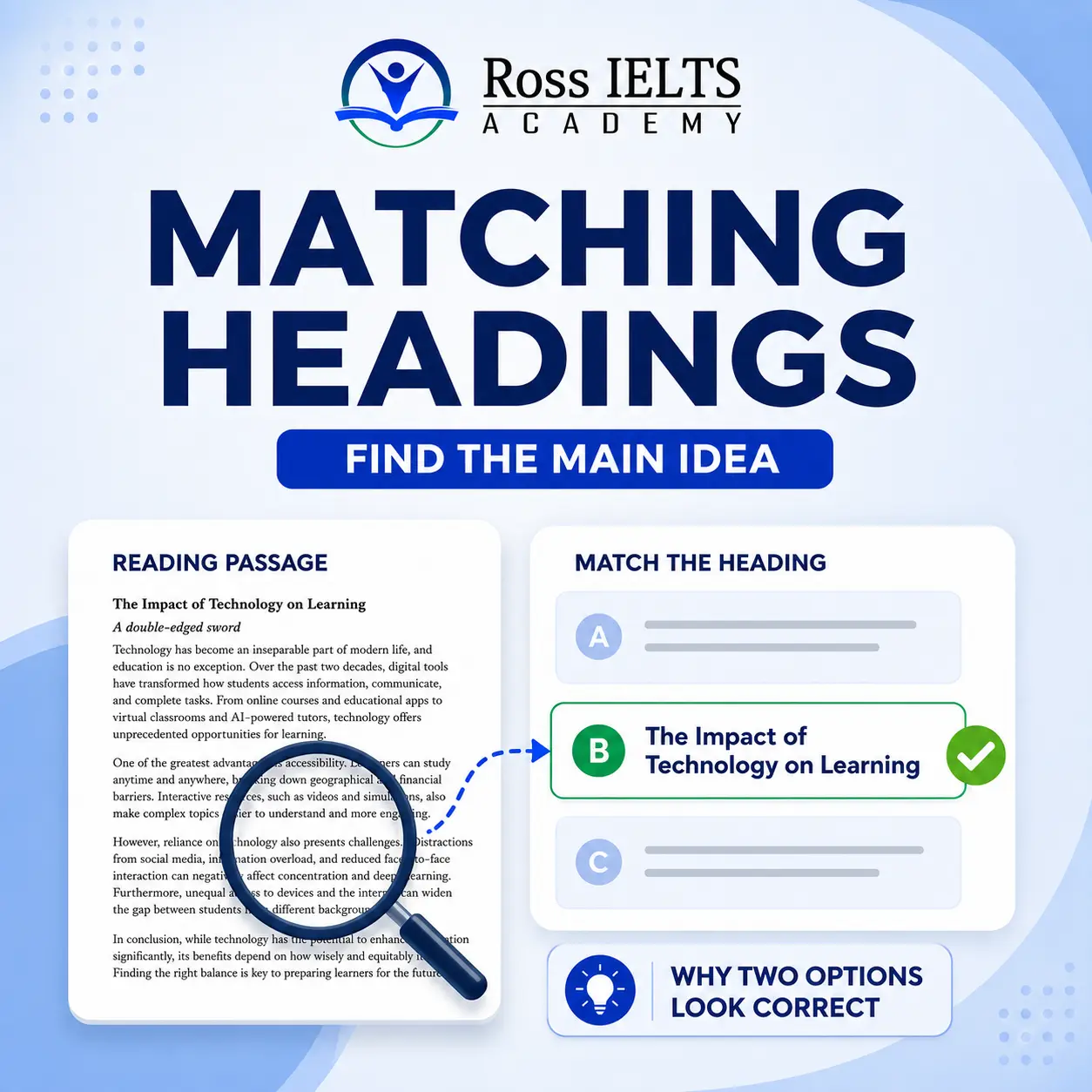
Do you understand the paragraph but still choose the wrong heading because two options seem correct?
The problem may not be your vocabulary. You may be matching a heading to one repeated word or one interesting detail instead of identifying the main idea of the whole paragraph.
This guide shows you how to recognise the paragraph’s central message, compare similar headings, eliminate distractors, and make a clearer final choice under exam pressure.
Choose the heading that best summarises Paragraph A.
For decades, city planners treated trees mainly as decorative features. Recent research has changed that view. Urban trees can lower surface temperatures, reduce storm-water runoff, improve air quality, and create healthier public spaces. As a result, many cities now include urban forests in climate and public-health plans rather than viewing them as optional beautification projects.
Show the answer and explanation
Heading i is true, but it covers only one benefit: lower temperatures. The paragraph also discusses water, air quality, public health, and a wider change in city policy.
Heading ii covers the whole paragraph: trees were once seen as decoration, but they are now recognised as valuable urban infrastructure.
This IELTS-style example was created by Ross IELTS Academy for teaching purposes. It is not an official IELTS test question.
Choose the Heading That Covers the Whole Paragraph
A Matching Headings question is not asking you to find a true sentence. It is asking you to identify the heading that best represents the paragraph’s main idea.
Official format in simple terms: Matching Headings uses Roman-numeral headings, provides more headings than you need, and tests whether you can distinguish a paragraph’s main idea from its supporting ideas.
Why Do You Keep Choosing the Wrong Heading?
Choose the description that sounds most like your problem. Matching Headings mistakes do not all have the same cause.
The word may appear in a supporting example rather than the main idea.
A true detail is not automatically the best heading.
Without a short gist, every related heading may look possible.
You need a coverage test to identify which option represents the full paragraph.
Main Idea vs Supporting Detail
A paragraph can contain several facts, examples, causes, and results. The correct heading usually describes the central message that connects those details.
| Paragraph element | What it does | Heading risk |
|---|---|---|
| Main idea | Expresses the central message or purpose of the paragraph. | Usually the correct focus. |
| Supporting reason | Explains why the main idea is true or important. | May create a heading that is too narrow. |
| Example | Illustrates the main idea with a case, place, person, or event. | Often contains memorable exact words that attract you to a distractor. |
| Result | Shows a consequence of the main idea. | Can be relevant without representing the whole paragraph. |
| Contrast | Changes or qualifies the direction of the paragraph. | Ignoring words such as however may reverse your interpretation. |
The removal test: Imagine that one example or statistic is deleted. If the heading stops working, it probably describes a supporting detail rather than the paragraph’s main idea.
The Ross 4-Check Main-Idea Method
Use these four checks before choosing a heading. This is a practical decision tool, not an official IELTS formula.
Do not copy a full sentence. Write the central meaning.
Is the paragraph introducing a change, explaining a cause, presenting a problem, or evaluating a solution?
The best option should include the paragraph’s major points without becoming too broad.
Then compare the final two choices by scope and purpose.
When Two Headings Both Look Correct
Public libraries were once judged mainly by the size of their book collections. Although printed material remains important, many libraries now provide digital equipment, job-search support, language classes, collaborative work areas, and access to trained staff. This change reflects a broader shift from storing information to helping people use information and participate more fully in community life.
Step 1: Write the gist
Possible gist note: libraries have broader community roles.
Step 2: Compare the strongest two options
This is true, but technology is only one item in a longer list. It does not cover job support, classes, staff, workspaces, or the paragraph’s final message.
This covers the full change from book storage to a wider range of information and community services.
Step 3: Check the writer’s purpose
The writer is not mainly listing technology. The writer is explaining how the purpose of libraries has changed. Therefore, heading ii is the best answer.
Should You Read the Headings or the Paragraph First?
Do not study every heading deeply before reading. You may start forcing headings onto paragraphs before you understand the writer’s message. Use this sequence instead:
Notice contrasts such as problem versus solution, past versus present, or cause versus result.
Pay special attention to the opening, contrast signals, and conclusion.
For example: “libraries gain wider roles.”
Look for paraphrase and full coverage, not repeated vocabulary.
Topic sentence reminder: The main idea often appears near the beginning, but not always. A word such as however, yet, or instead may change the paragraph’s direction later.
Five Types of Matching Headings Distractors
Test the Ross Main-Idea Method
Choose the best heading for Paragraph C before opening the explanation.
Early attempts to introduce bicycle-sharing systems often failed because users had to return bikes to a small number of fixed stations. Newer systems use mobile apps, wider station networks, and real-time information about availability. These changes have made shared bicycles more practical for short urban journeys, although cities still need to manage parking and maintenance carefully.
Show the answer and apply the four checks
Gist: newer changes improved bicycle sharing.
Purpose: explain a development from an unsuccessful model to a more practical one.
Coverage: heading iii covers apps, wider networks, availability information, and the overall result.
Elimination: headings i and ii describe real details, but only one part of the paragraph. Heading v focuses on one tool rather than the whole change.
Common Mistakes in IELTS Reading Matching Headings
Your Final 15-Second Check
IELTS Reading Matching Headings FAQ
Quick answers to the questions candidates often ask about this task type.
What does Matching Headings test in IELTS Reading?
Are there always extra headings?
Can I use the same heading twice?
Should I look for the same words in the paragraph and heading?
Is the main idea always in the first sentence?
Should I read the whole passage before answering?
What should I do when two headings seem correct?
Does Matching Headings appear in both Academic and General Training Reading?
What should I do if I am still unsure?
Is Matching Headings the same as Matching Information?
Ross IELTS Academy is an independent IELTS preparation provider and is not affiliated with IELTS, IDP, the British Council, or Cambridge. The practice questions in this guide are original IELTS-style educational examples and are not official test materials.